Description
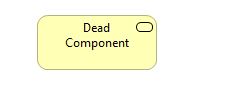
A component is no longer used (usually because it is now obsolete). Or you have generic or abstract elements that are not actually needed today. Such components often exists to support future behavior, which may or may not be necessary in the future.
Context
Derived from: “Dead Code”
Dead Code is software or lines of code that are no longer used or have become redundant but, for safety’s sake, remain in the code base.
Cause
When requirements have changed or corrections have been made, nobody had time to clean up the old structure. Sometimes components are created “just in case” to support anticipated future features that never get implemented.
Consequences
Unused elements increase the complexity which harms the readability and maintainability.
Detection
In ArchiMate, a dead component is a component that is not integrated into the model. We can detect the Dead Component EA Smell via KG query when a component has neither incoming nor outgoing edges. Search for isolated elements: The element respectively its cluster has no incoming or outgoing relations to other components (structural relations can be neglected).
Solution
Delete unused elements. Redistribute the functionality and aggregate components.
Example
A policy or programmatic relationship may require the purchase and usage of a particular piece of hardware or software. The consequences for managers and developers are that significant effort may have to be devoted to making the product work. After a significant investment of time and resources, the staff realizes that the product is useless in the current context, and abandons it for another approach. Eventually, the Boat Anchor is set aside and gathers dust in some corner (if it’s hardware).
Cypher query
MATCH p = (n) <br /> WHERE NOT ()--(n) <br /> RETURN pCypher count query
MATCH (n) WHERE NOT ()--(n) RETURN count (distinct n)Diagram
Aliases
dead Code, Boat Anchor
Tags
business, application, technology, The Dispensables, within elements, automatic detection
Related smells
- Lazy Component (follows)
- Vendor Lock-In (follows)